AI tools can be priced in different ways, and it’s challenging because it scales with usage on traditional SaaS more aggressively.
Now, it’s been common recently that value-based pricing or outcome-based pricing is gaining popularity with AI, and that is a good thing because it encourages the owner to make the product better and take part in the outcome or the value just generated.
The following is a transcript from a talk by an investor on Delphi’s YouTube channel.
*But I would also encourage people to adopt a value-based pricing mindset with AI. What has really changed with AI is two things:
- Increased autonomy
- Increased attribution This means you have more pricing power.* So avoiding the cost-plus mindset. If you’re in a cost-plus mindset, naturally if the costs are going down you’re going to keep changing price to reflect the costs. But if you’re in a more value-based mindset, then you are basically when the costs go down, that’s when you will actually get margin and you can actually then say, “Okay, it’s not just revenue, but it’s durable revenue.”
Should you be on usage? Should you be on outcomes? Those are all day one questions because you’re starting to train your customers on how to actually engage.
We actually developed a pretty cool 2x2 framework in scaling innovation. We can talk about that if you want as to when to pick which model. Let’s talk about it.
Okay? Cool.
So when you think about AI company specifically what has happened? Autonomy and attribution. So think about a 2x2 where autonomy on the Y axis from low to high and attribution on the X axis from low to high. I love 2x2, so I’m going to persist with that.
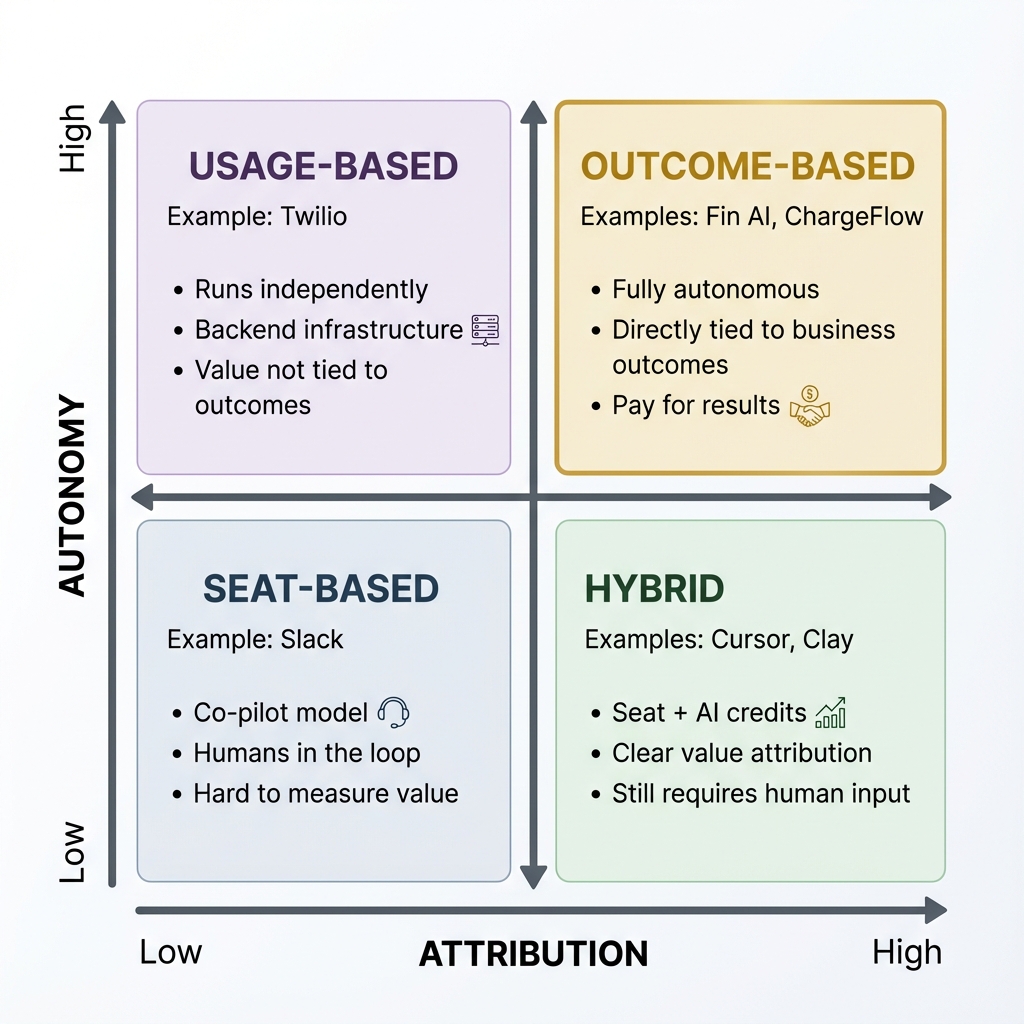
If you take the bottom left quadrant, it is where autonomy is low and attribution is low. When I mean autonomy, that means you’re running it in a co-pilot model, you still need humans in the loop, the AI cannot be fully autonomous. When I say low attribution, it means that your products kind of help with the co-pilot motion, but they don’t necessarily translate into key business outcomes that your customers are tracking. If you’re in that quadrant, most likely you have to be in a seed-based model because you’re co-pilot and you can’t attribute too much value.
So, for instance, take Slack which was a great company in the previous vintage. You can say, “My productivity went up when I used Slack.” You cannot measure it, you cannot monitor it, you cannot charge based on it. The attribution is weak, but it’s a co-pilot and it’s an interesting product, so it’s a seed-based model.
If you go to the bottom right where attribution is higher but our autonomy is still lower, you get into hybrid models. So, these are companies like Clay or Cursor. They actually have a seed-based model, but they also layer in AI credits, so each plan comes with a certain amount of AI credits that he can use. If you use it, then you need to buy packs of AI credits. These are hybrid models because attribution is more clear because you use Cursor or Clay, then you know that, “I could write my code much better with Cursor for instance,” and there’s clearly attributable, and you save time for people in writing code, etc., but it’s still in a co-pilot mode, so they’re in the hybrid model.
If you take the top left quadrant, where autonomy is high but attribution is low, most likely your back-end infrastructure play which is running on its own, doesn’t need humans in the loop, but the attribution is still not fully aligned with business outcomes. So, like Twilio is a great example, it’s on a usage-based model in that quadrant. The golden quadrant to be in, and this is not for everyone, is if you’re fully autonomous and also fully attributable. If you are in that quadrant, then you can be on an outcome-based pricing model because the AI does things on its own and it’s clearly valuable. So, then you can be on an outcome-based model. Finna is a great example, they actually are in that quadrant where the agent runs itself, resolves the tickets, their customers would say, “The ticket is resolved, the humans didn’t even come in the loop,” so they charge based on a ticket resolved by AI agent. If humans are required, they don’t charge for it. Or companies like Charge Flow which actually recover chargebacks.